Climate CO2 Forecasting ML
Local-first forecasting and MLOps demo with backtesting and interval monitoring.
- Project type
- ML/MLOps / Forecasting
- Core stack
- Python, Forecasting, Backtesting
- Delivery
- Case study
Case Study
The problem, implementation decisions, measured evidence, and next improvements.
Overview
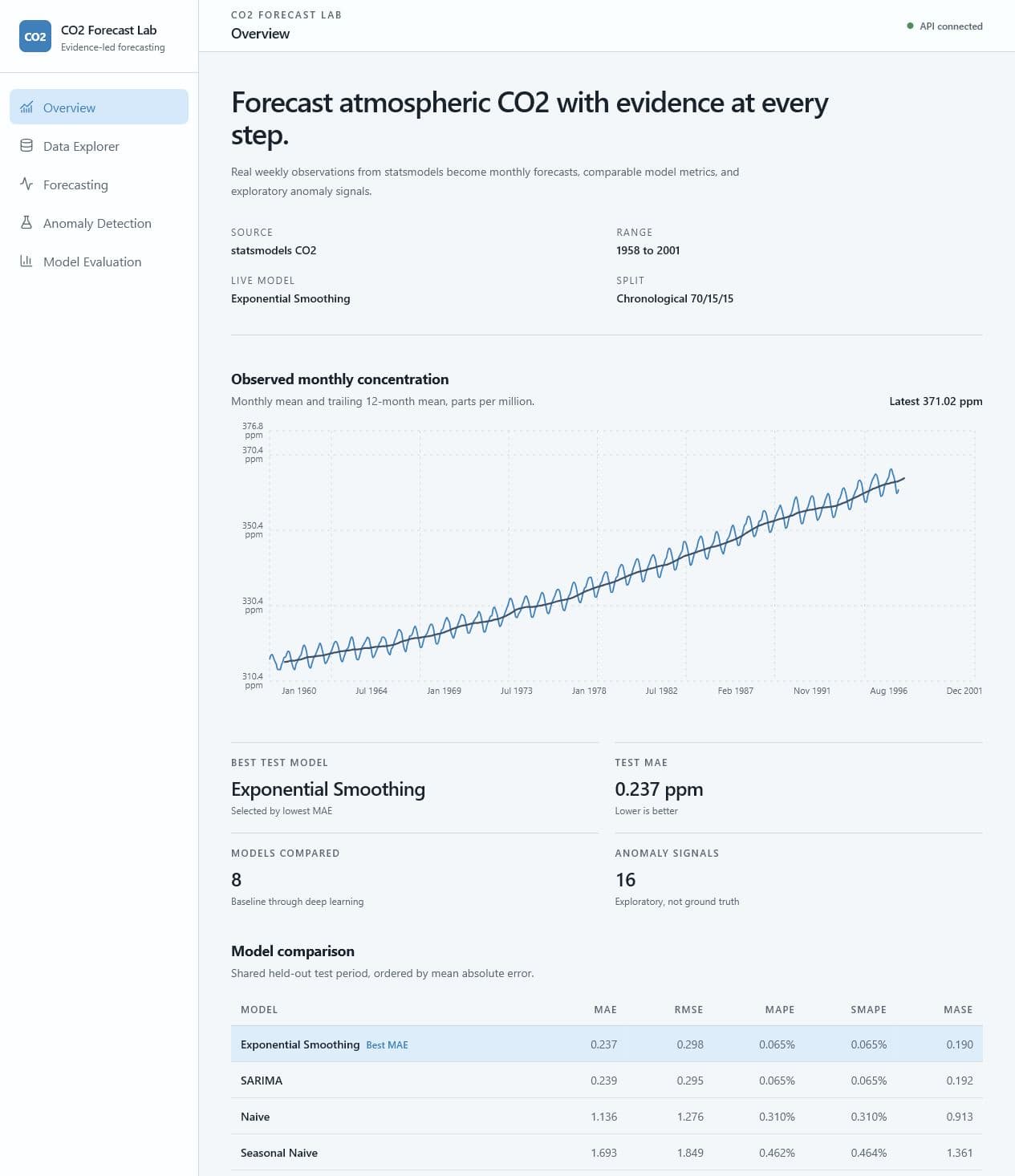
A forecasting workflow spanning validation, backtesting, interval monitoring, experiment evidence, serving, and visualization.
Problem
Time-series models can appear strong when evaluation leaks future information or compares models on inconsistent windows.
Solution
Built a reproducible forecasting workflow with leakage-safe rolling backtesting, interval evaluation, experiment tracking, registry-style metadata, API contracts, and a frontend evidence view.
Technical Decisions
- Chronological evaluation is shared across model families.
- The local deterministic demo remains separate from optional hosted infrastructure.
Outcome
The project keeps model comparison reproducible and reports limitations instead of treating model complexity as evidence of quality.
What It Proves
Time-series validation, model comparison, experiment tracking, model metadata, API delivery, and honest ML communication.
Key Features
- Rolling-origin evaluation prevents future leakage.
- Interval monitoring complements point forecasts.
- Experiment and registry metadata connect training evidence to serving.
Architecture
- 01
CO2 dataset
- 02
Validation
- 03
Rolling backtest
- 04
Model comparison
- 05
Interval evaluation
- 06
Registry metadata
- 07
API and frontend
Tech Stack
- Python
- Forecasting
- Backtesting
- Intervals
- FastAPI
- React
- Experiment tracking
Verification
- Leakage-safe rolling backtesting
- Interval evaluation
- Offline deterministic demo and API checks
Security & Privacy
- The workflow uses public climate data and requires no private user data.
- Environment-specific credentials are not part of the default review path.
Limitations
- Forecast results are an educational engineering demonstration, not climate-policy guidance.
- Public repository evidence is provided without claiming a live full-stack deployment.
Future Improvements
- Extend probabilistic forecast calibration.
- Compare additional rolling windows and drift signals.
Claims limited to documented repository artifacts and reproducible local outputs.