Customer Support RAG Triage Agent
Offline-capable RAG triage system for support tickets with grounded responses.
- Project type
- RAG / AI Agent Systems
- Core stack
- Python, FastAPI, RAG
- Delivery
- Demo available
Case Study
The problem, implementation decisions, measured evidence, and next improvements.
Overview
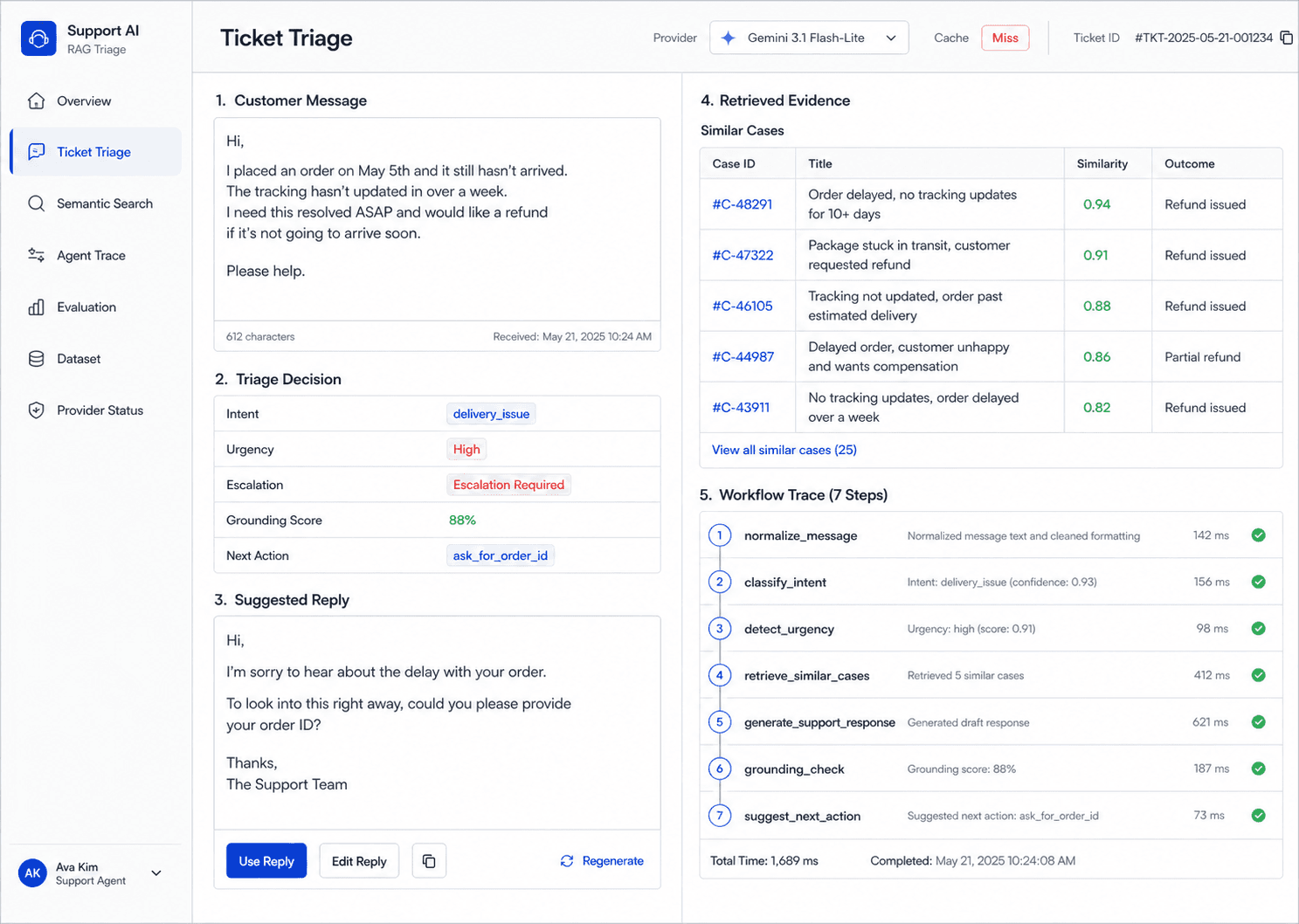
A retrieval-grounded support triage workflow with observable steps, citations, evaluation, and fallback behavior.
Problem
Support triage combines classification, retrieval, response drafting, and escalation decisions that need to remain inspectable and safely bounded.
Solution
Built a typed workflow for ticket normalization, intent and urgency handling, retrieval, grounded answer generation, source checks, and safe fallback behavior.
Technical Decisions
- A fixed workflow replaces an open-ended agent loop.
- Provider failures degrade to bounded output rather than bypassing guardrails.
Outcome
The project provides an API contract, a deterministic offline path, evaluation artifacts, guardrails, and a public reviewer demo.
What It Proves
Retrieval, ranking, grounded generation, guardrails, offline evaluation, API contracts, and full-stack delivery.
Key Features
- Typed workflow state keeps triage behavior inspectable.
- Grounding and source checks constrain generated responses.
- Offline evaluation and deterministic fallbacks preserve a stable review path.
Architecture
- 01
Ticket input
- 02
Intent and urgency
- 03
Retrieval
- 04
Ranking
- 05
Grounded generation
- 06
Source checks
- 07
Human action
Tech Stack
- Python
- FastAPI
- RAG
- LangGraph
- Qdrant
- React
- TypeScript
- Evaluation
Verification
- Offline deterministic demo
- Retrieval and grounding evaluation
- API contract checks
Security & Privacy
- Provider credentials remain server-side.
- Guardrails and escalation preserve human review for uncertain output.
Limitations
- The bundled support corpus is a review fixture, not a private production knowledge base.
- Generated drafts still require policy-aware human review.
Future Improvements
- Add stronger reranking and multilingual retrieval.
- Capture structured reviewer feedback for evaluation.
Repository, evaluation artifacts, and public deployment are the evidence sources.